Why Permission Granularity in Internal Tools Is an Organizational Design Problem Not a Database Problem
Decide who owns each dataset before configuring who can access it.
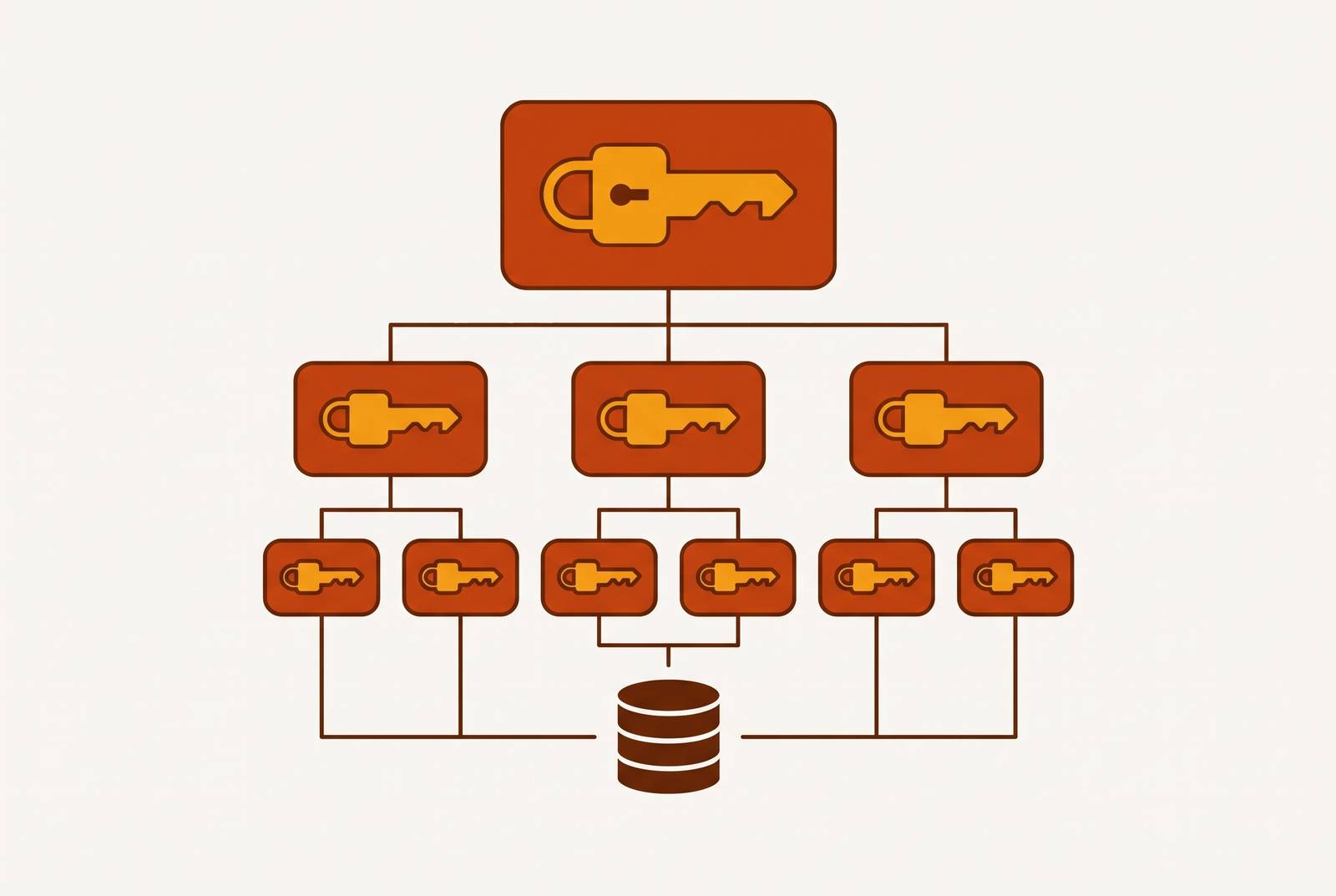
Least-privilege access control for internal database tools starts with deciding what each job needs, then enforcing that decision with row-level rules, column masking, and role-based access. Giving sales or support useful access without exposing sensitive fields or allowing unrestricted exports requires explicit agreements about those boundaries. Permission granularity is therefore an organizational design problem before it is a database configuration problem.
Why permission granularity looks like a configuration problem and isn't
The engineering team has finished the permissions work. Roles are defined, row-level security is enabled, and the dashboard has the right toggles. Yet requests for access keep coming, while people use emailed files to answer other questions outside the system. How can the work be finished if the decisions keep coming? Because the team has completed the enforcement layer while leaving the agreement it was supposed to enforce unresolved.
The confusion starts with what is visible. A warehouse policy is an artifact someone can deploy, while agreement about a contractor’s need for customer PII requires named people to make and maintain a judgment. The database can enforce a rule about pre-release financials, while deciding which job function should see them requires human judgment. Mistaking those two kinds of work makes governance look complete just when its hardest questions have been postponed.
How the permission queue forms and what it costs the organization
When no one is named as the dataset owner, a request for access goes to whoever holds the keys. That is usually a data engineer or DBA, whose knowledge of the requester’s work may be limited. The engineer must decide whether the request is reasonable with incomplete context, or find someone else who can decide. The central team becomes the company’s human API, except this API has meetings and would occasionally like lunch.
Engineering work is interrupted, non-technical teams wait, and the next request joins the same queue because the previous answer did not establish a reusable rule. A self-serve interface changes little under those conditions. It lets someone discover what they cannot reach, then sends them back to the people the interface was meant to free from routine requests.
When that governed route is slower than asking a colleague for a CSV, the colleague becomes the practical route. Emailed spreadsheets and the copies people keep for themselves then become systems of their own, outside the original controls. The permissions may still be working exactly as configured. What failed was the decision process surrounding them, which made a controlled answer harder to obtain than an uncontrolled copy. For governance to survive everyday work, the fastest path to an answer must also be the governed one.
The two failure modes: over-restriction and under-restriction both start from the same missing agreement
Over-restriction begins with an understandable instinct to reduce risk. Someone has to approve every request and classify every dataset, and no one has agreed which everyday tasks can go ahead without another review. The resulting tool is self-serve in name only. Non-technical teams still rely on IT-mediated reporting, while the central team handles requests that could have been answered by an agreed definition of the role.
Under-restriction starts with the opposite urge, to make the work easier. Broad access gets people moving, but when no one has agreed on boundaries, teams can export sensitive files and keep their own stores of data outside the governed system. Different teams calculate the same metric differently, dashboards contradict one another, and users trust only the numbers produced in their own corner. The missing agreement turns convenience into an ungoverned playground.
These are mirror images. In one, nobody has decided what access is sufficient, so almost nothing is allowed without intervention. In the other, nobody has made that decision, so almost everything is allowed. A permission editor with more detail cannot decide which of those choices to make. Both configurations encode an assumption about work that no accountable owner has tested.
Spreadsheets complicate this picture because they are also ordinary working tools. Alteryx research establishes that a large majority of data analysts still rely on manual spreadsheet work for data preparation. Blocking spreadsheets treats the destination as the problem. Feeding governed numbers into them accommodates how people work, but it still requires agreement about what those numbers mean. If one team defines “revenue” and another presents a different calculation under the same name, shared table access cannot tell either team which definition has authority.
What real breaches reveal about where the permission failure actually happened
Coinbase’s insider incident, disclosed in February 2026, involved a contractor improperly accessing customer data in December 2025. The contractor used access granted for a support role without a legitimate business need. The key distinction is between access and purpose. The tool had access controls, but the role’s scope was too broad for the work the contractor legitimately needed to perform. A permission can be valid in the system and unjustified in the organization.
Row-level records already existed, and the problem was not simply the absence of a place to write a rule. The needed restriction depended on defining the contractor’s proper scope. More generally, when excessive grants are left in place, the unanswered questions concern accountability and review. Who is responsible for deciding whether those rights still match the role?
TransUnion’s SEC 10-K says that in its July 2025 cyberattack, a third party used social engineering to gain unauthorized access to a third-party application. The application was connected to its Salesforce environment, which contained Social Security numbers and credit-related data. An integration creates another boundary through which access can occur, and its granted scope becomes part of the organization’s exposure.
The filing leaves some decisions about what that connection could reach unclear, so attributing the incident to a particular misconfigured database policy or an undocumented review failure would exceed the evidence. A third-party application needs an accountable owner for its access scope just as a support role does, because database controls alone do not settle what that connection should be allowed to reach.
Why AI agents and conversational BI make unresolved ownership questions materially more dangerous
Agents that automate data work run on service accounts, inheriting the access those accounts have been granted. An over-broad role can therefore support continuous queries across a dataset beyond a single person’s session. The identity persists after the immediate task is forgotten. Unreviewed credentials and wide-open permissions do not become safer because their user is software.
Who owns the agent’s scope, who reviews it, and who can revoke it? A service account answers none of those questions. It expresses the grant while leaving its justification unresolved, so an agent built on unresolved permissions can amplify the same gap that once produced a slow access queue. Automation accelerates execution without supplying accountability.
Conversational BI adds a different kind of uncertainty. An employee can ask a free-form question whose answer may involve customer data, pricing, and payroll. What, exactly, can a vague question reach? Natural language injection, requests that are unclear, and query rewriting make that question harder to answer, and SQL-oriented row-level rules still need to hold as the request is translated. Audit logging must also cover natural language interactions, rather than being assumed to exist because the database has logs.
Pinterest’s natural language analytics agent illustrates a governance approach to that problem. Its governed semantic layer was built on DataHub, while Querybook was the SQL IDE where the agent appeared. The semantic layer was an organizational artifact that helped make deployment to a large share of the analyst population safe. AI makes ownership of data, definitions, and access scope more urgent.
What "clarifying ownership first" actually requires in practice
The practical response starts with assigning and recording ownership. A dataset’s owner is the person or team accountable for its correctness, classification, and access decisions. Storage location is not a job description. Naming the owner gives someone authority to approve, deny, or delegate, while recording that authority prevents it from living only in someone’s memory. Otherwise, every request remains a fresh negotiation.
Roles should then be designed around functions. Role design depends on answering what actions a person needs to take, on which datasets, to complete the job. An organizational chart cannot answer that reliably. A sales analyst’s title, for example, does not say whether the job needs access to Q4 earnings before release. Least privilege is the judgment that resolves that question before a role encodes the answer.
That judgment also needs to distinguish routine requests from exceptions. Organizations should define which role-and-dataset combinations are low-risk enough for automatic approval and which require a person’s review. Someone must own that distinction before software can apply it. Without it, even an ordinary request returns to the queue, and the organization recreates the friction that encouraged uncontrolled copies. Automation works here because the relevant judgment has already been made.
Access reviews should be scheduled, assigned, and enforced. A grant that made sense when it was given can allow too much access as duties change, integrations change, or datasets are retired. The review cycle is the organizational garbage collector. Its job is to revisit accumulated rights, with a named owner and a defined cadence, rather than assume that an old approval remains a current justification. The same responsibility applies to human roles, service accounts, and third-party integrations.
Metric definitions also need a named owner before anyone is given access. If two teams calculate “revenue” differently, opening the same table to both may simply postpone discovery of the disagreement until a board meeting. The organization needs a canonical definition and someone with authority to maintain it, because permission to read a number is not agreement about what that number means. That is the boundary between access control and shared understanding.
How to restrict rows and columns in an internal database tool once organizational agreements exist
Row-level security, column masking, role-based access, and audit logging can do their jobs once the decisions behind them are settled. For non-technical teams, the concrete distinctions include which records they can reach, which fields they can see, which actions they can take, and whether they can export data. These are not interchangeable controls. A row restriction does not itself answer whether a sensitive column should be visible, and permission to view data does not settle permission to take a copy.
Access should be enforced as close to the data as possible, through warehouse-level roles, engine-level row restrictions, and native column masking. That is sound for enforcement. Queries arriving from Slack, AI assistants, dashboards, or conversational interfaces should not become routes to greater privilege. Keeping the rules near the data reduces dependence on each interface implementing its own version of access logic.
But correct enforcement does not make organizational agreements redundant. The warehouse cannot decide which dataset a role needs, how much scope an integration should receive, or whether a contractor’s access should expire. Those remain decisions about work and responsibility. Warehouse-level enforcement of a badly designed role is perfectly executed bad governance, which is an impressive way to get the wrong answer consistently.
Once roles and classifications are sound, tooling can apply them without multiplying the review queue. Matching requests can be approved automatically, and database-native self-serve access can let non-technical users work without raw credentials or SQL. Audit trails then make reviews tractable. An owner needs a record of who queried what, when, and with what result, but the record becomes useful only when someone is responsible for reading it.
That division of labor also changes the work of engineering. Instead of answering every routine access question, the team can express an agreed boundary in the tool and let users work within it. The arrangement still needs human attention over time. Roles accumulate, owners change, and datasets are deprecated, so the ownership record and definition of sufficient access need maintenance even when enforcement is reliable. The database can keep applying yesterday’s agreement perfectly long after the organization has stopped living by it.