The Database GUI That Lets Non-Engineers Query Directly Without Becoming a Support Ticket
Business users answer their own data questions without waiting for an analyst.

A sales ops manager needs to know which enterprise accounts haven't logged in this month. A support lead wants a contact list for customers on the enterprise plan. Both questions have the same destination: a ticket filed with the data team, followed by a wait.
The bottleneck persists because data access is architecturally gatekept, not because engineers are slow or non-engineers are incapable. At companies where data is "mature," there's usually a warehouse, a BI tool, and a queue. The tooling has grown, but the pattern hasn't changed. A business user has a question, cannot reach the data, messages an analyst, waits, and gets an answer that may already be stale. Next week, a variation of the same question starts the cycle again.
The data team becomes, in practice, an army of English-to-SQL translators. This framing captures the failed state precisely: every question flows through an analyst, no answer is reusable, and analysts burn out on repetitive work. Hiring more analysts doesn't scale, because the queue isn't a staffing problem. The capacity constraint is structural. Demand for data answers grows with company size, but the team fielding those requests cannot grow proportionally without becoming its own management problem.
What is the strongest objection here? It's that "we just need better ticketing or prioritization." Triage doesn't reduce demand. It just reorders it. The requests keep coming regardless of how well the queue is managed. In fact, the queue is self-reinforcing. Engineers who clear it create the expectation that tickets will be answered, which generates more tickets. A faster translator doesn't reduce the number of translation requests.
What self-serve data access actually means, and what it requires to hold together
Self-serve analytics is a business outcome, not a feature set any one tool automatically delivers. It's the state where a non-engineer can answer their own question without sending a message. The clearest definition inverts the question: self-serve is valuable specifically because it avoids the failed state where business users can't get data without filing a request.
Three prerequisites the outcome requires, regardless of tool chosen. First, data the non-engineer can reach without raw credentials or SQL knowledge. Second, definitions they can trust, so metrics mean the same thing across teams. Third, permissions that let them explore safely without risking production data.
Without all three, "self-serve" is just a dashboard someone else built. That recreates a different version of the same dependency. Self-service BI shifts data from being IT-controlled and request-driven to being directly explorable by the person with the question. Speed to insight moves from days to the time it takes to open a tool.
The cultural component matters more than tool choice. Whether a team trusts the numbers and feels comfortable self-serving depends on organizational context and data maturity. A tool can remove an architectural barrier without removing a cultural one. The self-service analytics market reached $14.01 billion in 2026, which tells you how many companies are chasing this outcome.
Where traditional BI tools fall short for the teams they're supposed to help
Many BI tools move the bottleneck rather than remove it. They still require a technical person to build the semantic layer, maintain the dashboards, and handle anything the prebuilt views don't cover. The dependency chain shifts from "ask an engineer for a SQL query" to "ask an analyst to update the dashboard or add a field." The ticket still gets filed, just to a different queue.
Enterprise-grade BI platforms are built for scale and governance at large organizations. A roughly 100-person company deploying one inherits all the setup complexity and ongoing maintenance without the team to sustain it. Natural language query features help close the gap, but they depend on a well-maintained semantic layer underneath. If the semantic model is incomplete or stale, NLQ returns wrong or misleading answers, and the non-engineer has no way to know.
One might argue: can't the data team just build dashboards once and be done? Business questions evolve. New dimensions get requested. One-off dashboards become a maintenance backlog faster than the team can keep up. For teams without a dedicated BI or data engineering function, standing up and maintaining a separate BI layer is itself an engineering project. That defeats the purpose of self-serve. Organizations implementing self-service platforms report 50% reductions in analysis time, but the setup burden is real. So what if the layer between the non-engineer and the database were thinner?
How a database GUI creates a direct path from question to data without engineering involvement
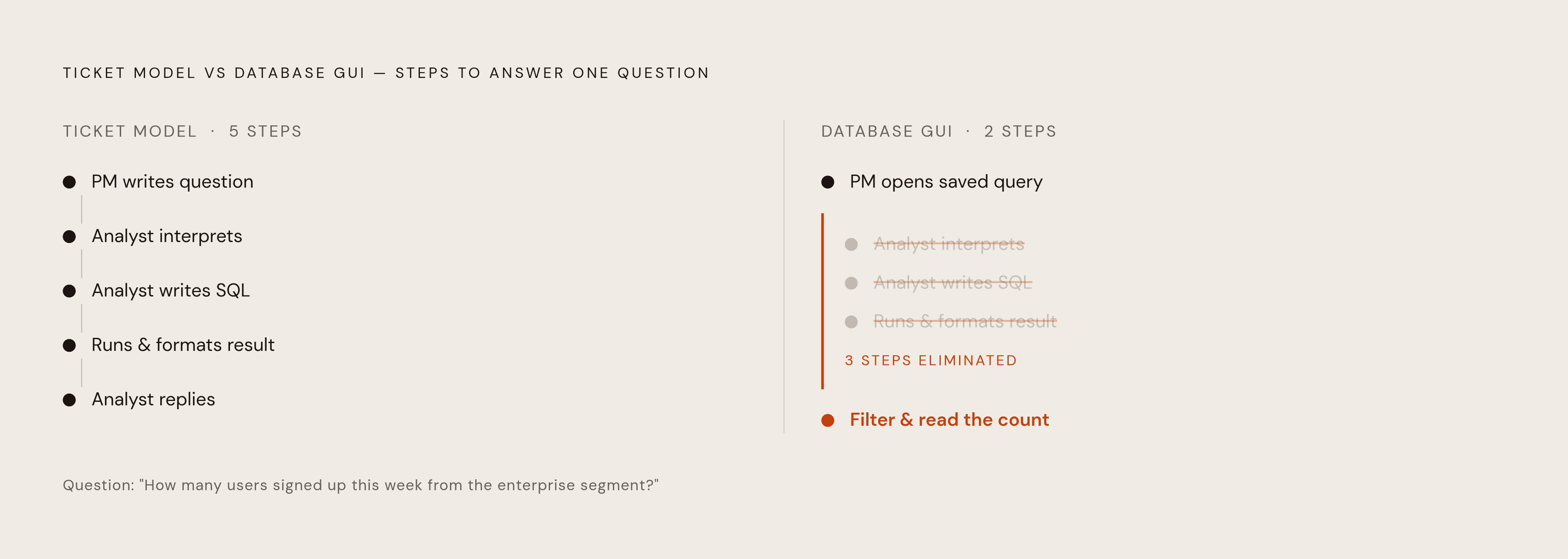
A database GUI removes the translation step entirely. Instead of a non-engineer describing a question that an engineer translates into SQL, the non-engineer explores data directly through an interface built for that purpose. The "sideways" mechanism is what makes this work: the request disappears not because engineers answer it faster, but because the person who had the question can now answer it themselves. The queue shrinks because it stops receiving submissions.
Trace one question: "How many users signed up this week from the enterprise segment?" In the ticket model, a product manager writes this question to an analyst. The analyst interprets it, writes SQL, runs it, formats the result, and replies. In a database GUI model, the product manager opens a saved query, filters by date and segment, and reads the count. All the intermediate steps disappear. The key architectural difference is that a database GUI sits directly on the production database rather than requiring a separate data pipeline, semantic layer, or warehouse sync. The data is always current because it is the data.
For a non-SQL user, this means browsing tables, filtering rows, and running saved queries through a UI. No query writing is required for most everyday questions. For the engineering team, it means one connection to maintain rather than a BI stack, a pipeline, a warehouse, and a set of dashboard definitions. Saved queries and shared views mean common questions get answered once and become reusable for the whole team. The same question doesn't generate a new ticket each time.
Basedash connects directly to Postgres, MySQL, Snowflake, BigQuery, ClickHouse, Redshift, SQL Server, and other databases. It turns those databases into dashboards, editable data views, and saved queries. An engineering team sets it up once, and teams across product, sales, marketing, support, and ops use it without needing SQL or ongoing engineering help.
What permissioned access means in practice and why it is the part that can't be skipped
Giving non-engineers access to a database without row-level permissions and access controls doesn't solve the ticket problem. It trades one risk for a worse one. The obvious danger: a single misclick on a production table, an accidental update or delete, can corrupt data that is very hard to recover.
The less obvious danger is what read access alone enables. A business analyst with read access to a customer table can export records to a local file and share it externally without any permission being technically violated. The gap is not the permission level. It is what unrestricted read access enables downstream.
Role-based access control (RBAC) scoped to specific tables, columns, and row sets is the answer. A support rep can query their own customers' records without seeing all customers. The scope of exploration matches the scope of the job. Just-in-Time access takes this further: elevated permissions granted only when needed, for the minimum required duration, then automatically revoked. That reduces standing privileges and aligns with Zero Trust approaches.
Source pages for Basedash confirm that row-level permissions are a supported feature. The blog states that "non-technical users query governed models with metric definitions baked in" while row-level security is "enforced at the database level." In other words, engineering sets the rules once, and the tool enforces them consistently without requiring ongoing oversight of each query.
But what about the objection that governance is too complex to manage in a small team? A well-configured permissioning model at setup is far less work than reviewing every ad hoc data request. The upfront cost is lower than the ongoing cost of being the bottleneck. The "role sprawl" failure mode is real: over time, organizations accumulate too many roles through project handoffs and team changes, creating inconsistencies that are hard to audit. But that's a maintenance problem with a clear fix, not a reason to avoid permissioning entirely.
What the engineering team's setup responsibility actually looks like
The engineering team's role in a database GUI model is to build the access structure once, not to field every data question forever. Setup involves connecting the database, defining which tables and columns are accessible to which roles, creating saved queries for common questions, and building the dashboards that replace recurring report requests. After setup, the engineering team's involvement is maintenance and evolution. Adding a new table as the product grows. Adjusting permissions when someone changes roles. Not answering individual questions. This is structurally different from maintaining a full BI stack: no pipeline to monitor, no warehouse sync to debug, no dashboard definitions to keep aligned with schema changes in a separate system.
The force-multiplier argument is the strongest one here. One engineer's setup work serves the whole company across product, sales, marketing, support, and ops, without those teams waiting on that engineer for day-to-day answers. Compare that to the alternative: building and maintaining a custom internal admin panel requires ongoing engineering attention every time the schema changes or a new use case emerges. A database GUI with a maintained connection handles schema changes without rebuilding the tool.
The types of questions non-engineers can answer themselves once access is set up
Most of the tickets a data or engineering team receives from non-engineers fall into a small number of repeating patterns. These are exactly the patterns a permissioned database GUI handles without any engineering involvement. Sales and support teams ask things like: "How many active accounts in this segment?" "Which customers haven't logged in this month?" "Pull the contact list for accounts on the enterprise plan." All answerable by browsing a permissioned view of the right tables.
Product teams ask: "How many users completed the onboarding flow this week?" "What's the breakdown of feature usage by plan tier?" Answerable from saved queries on usage tables without writing new SQL. Marketing and ops teams handle campaign attribution lookups, cohort membership checks, and record edits for data hygiene. These are handleable through editable data views with write permissions scoped to the right columns.
The pattern across all of these: the question is about current production data, it is time-sensitive, and it recurs in slightly different form each week. That is exactly the profile of requests that generates the most friction under the ticket model. Self-service BI tools in practice serve marketing, HR, sales, finance, operations, and e-commerce teams with questions that are fundamentally about their own domain's data. Those questions don't need engineering expertise to answer, only access. The self-service analytics market represented 18.4% year-over-year growth.
So what stays in the ticket queue? Schema changes. Complex multi-table joins across poorly documented relationships. Anything that touches data the non-engineer doesn't have permission to see. These remain, but the queue is now a fraction of its former size.
What to verify before rolling out database GUI access to non-technical teammates
A database GUI doesn't fix the ticket problem if it's rolled out without the permissions, documentation, and data quality checks that make non-engineer access trustworthy. Here's the peer-to-peer checklist: what actually trips teams up. write permissions per role before any non-engineer connects. Row-level scoping is not optional for tables that contain customer or financial data. A database with undocumented table names shifts the dependency from "ask an engineer for the query" to "ask an engineer what the table is called." That's the same ticket with a different label.
Saved queries for common patterns. Identify the ten most common ticket types from the last quarter and build saved queries for each before rollout. This is what converts the rollout from "here's a tool" to "here are the answers you kept needing."
Audit logging. Know who ran what query on which table. Without statement-level logging, access governance is theoretical. Native database logs vary by engine and may not be sufficient on their own. Resolve known data quality issues before rollout or document them clearly. Otherwise, the first self-serve experience generates a new class of tickets: "Why does this number not match the dashboard?"
Governance review cadence. Set a calendar event to review roles and permissions every quarter. Role sprawl accumulates silently through team changes and project handoffs, and a periodic audit is the only reliable way to catch it.
Basedash's setup model maps directly to this checklist. Connect the database, configure permissions by role, build saved queries, and hand access to the teams who kept filing tickets. Once this is in place, the ticket queue for routine data questions largely stops. Engineering attention shifts back to work that actually requires engineering.