The One-Time Engineering Setup That Lets Every Department Query the Database on Their Own
One-time database setup lets non-technical teams answer their own questions independently.
For startup teams whose users cannot write SQL, a friendly interface alone is not enough for self-serve analytics. It needs database permissions, metric definitions that teams share, a governed query layer, and access policies that all work together. The engineering lift is a bounded setup, provided the team maintains the definitions and policies afterward.
Why the data request queue is a structural problem, not a staffing one
On Monday morning, requests pile up in the team chat. Twelve people ask the same question twelve different ways, and each request lands with someone who knows which table to use, which join is safe, and what “active” means this week. The SQL may be simple. The context is not available anywhere except inside a few heads, so every question must pass through them.
That is an organizational bottleneck. Hiring another analyst adds someone who can translate requests, but it leaves everyone else dependent on a translator. Analysts spend their days turning English into SQL, leaving little time to look into what the answers mean.
Dashboards help only with the questions their builders thought to ask. A stakeholder sees a change, asks whether it holds for a different customer group, and returns to the queue. The follow-up breaks the arrangement. Independent access therefore depends on making the context reusable, rather than putting more people between the question and the answer.
What "one-time setup" actually means — and what it does not
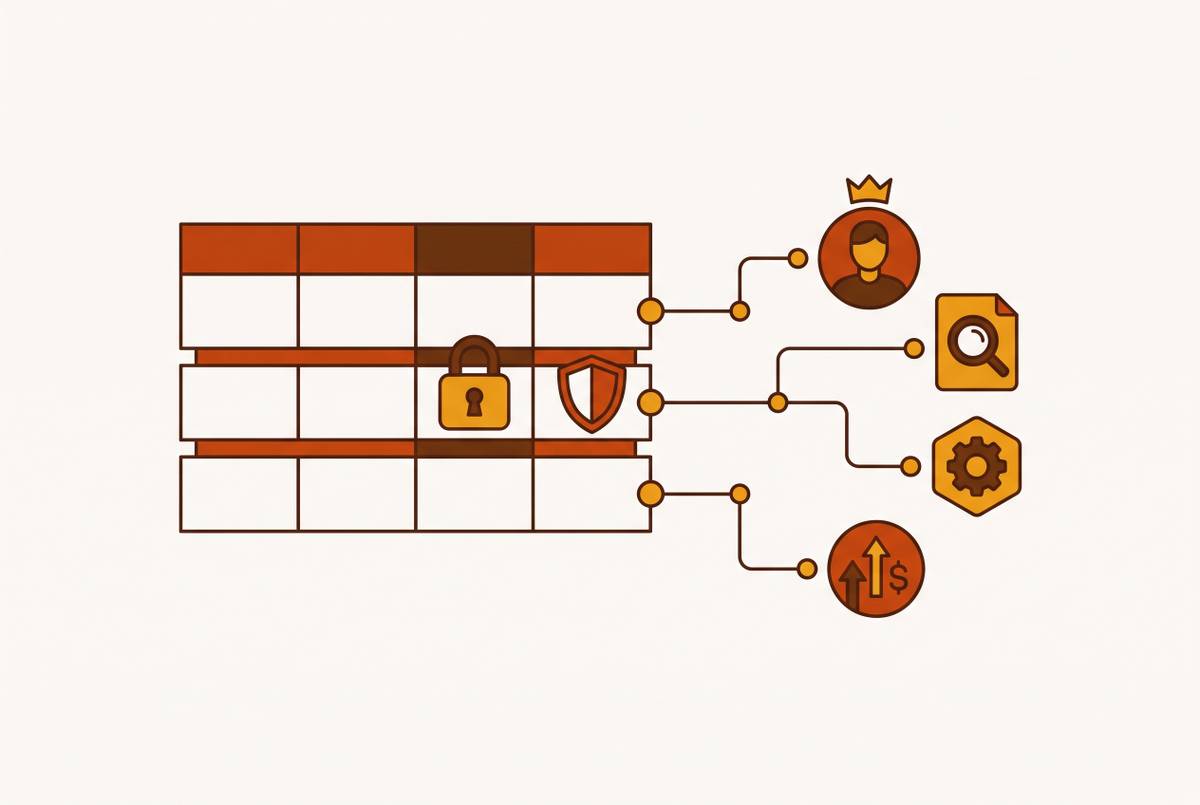
Self-serve access is a configuration of four layers, including database permissions and workload isolation, a semantic layer, a governed query interface, and role-based access policy. Each handles a different failure mode. A friendly interface cannot settle a fight over a metric, and a correct metric cannot keep users from seeing sensitive columns.
“One-time” means that the configuration is durable. Roles need not be redesigned for every new hire, and metric definitions can serve repeated questions across departments. The upkeep is real but different. Teams still need to keep data models up to date, change definitions when business rules change, and check access logs. Confusing that maintenance with the initial build makes teams either postpone the work forever or stop halfway through it.
Layer one: database permissions that make safe access physically enforced, not policy-dependent
A read-only role stops someone from changing data. It does not stop them from seeing too much. A support rep running a broad SELECT could still retrieve password hashes, API keys, or PII if the role exposes those columns. Safety begins with what the database permits.
PostgreSQL has column-level grants, and views can show just the columns a role needs. These controls keep sensitive fields out of reach, so the user does not have to remember which ones to avoid. Rows need boundaries too. For multi-tenant tables, row-level security restricts a user to the appropriate customer’s rows even when their query would otherwise return several customers’ records. The principle applies beyond one database product.
An analytics query joining three large tables and scanning months of records can pin the primary database and degrade application performance. That risk explains the hesitation around production access. Sending analytics traffic to a read replica keeps the workload separate, so the team does not have to trust every user to spot an expensive query.
A statement_timeout on the analytics role adds an automatic limit by canceling runaway queries. A non-technical user should not need to understand the cost of a cross join before asking a business question. The database supplies the guardrail. The same restrictions apply when an AI tool writes an over-broad query on the user’s behalf.
Layer two: defining metrics once so every department gets the same answer
Marketing calls a customer churned after a short period without a purchase, while finance counts a canceled subscription. Both query the same database and get different answers. Neither calculation is wrong by its own logic. But when both numbers arrive under the label “churn,” the data team inherits an argument that more access cannot resolve.
A semantic layer separates metric definitions from the interface used to ask questions. The team defines a metric centrally, and requests from different departments resolve against that definition. Permissions determine what someone may see. The semantic layer sets what the answer means, so each department does not open its own dictionary.
The dbt Semantic Layer uses MetricFlow to turn metric-plus-dimension requests into warehouse SQL from definitions written in YAML inside a dbt project. MetricFlow is open source under Apache 2.0 and free to run locally. Serving those metrics through dbt’s APIs is different. That requires a paid dbt platform plan, with the Starter tier beginning at $100 per user per month. Cube is a headless, API-first alternative, and AtScale is enterprise-grade, but teams still have to agree on definitions when they choose a product.
Older documentation presents a practical trap here. The dbt YAML spec changed in 2025–2026, and in dbt v1.12+ and v2, semantic models nest under models, while simple metrics replace measures. Tutorials showing measures and type_params reflect the deprecated older spec. Backward compatibility is still supported, though migration is recommended, and un-nested type_params for cumulative metrics raise a hard error in v1.12.
Layer three: a query interface that non-technical users will actually use without help
Which interface lets a non-technical founder explore data without writing queries? An SQL editor with autocomplete may help technical users without helping business users at all, while a natural-language interface can write and execute queries on their behalf. Tools sit across that spectrum, and the label “self-serve” does not reveal how much skill they demand.
The evaluation criteria follow from the work already done. Can a user ask in plain English and receive a governed answer, does the tool query live data rather than stale exports, and does the result stay tied to the team’s metric definitions? Connecting straight to the database avoids the version drift that can come from syncing data into a separate store. Role controls in the interface back up the database restrictions, so people who share an interface do not have to see the same data.
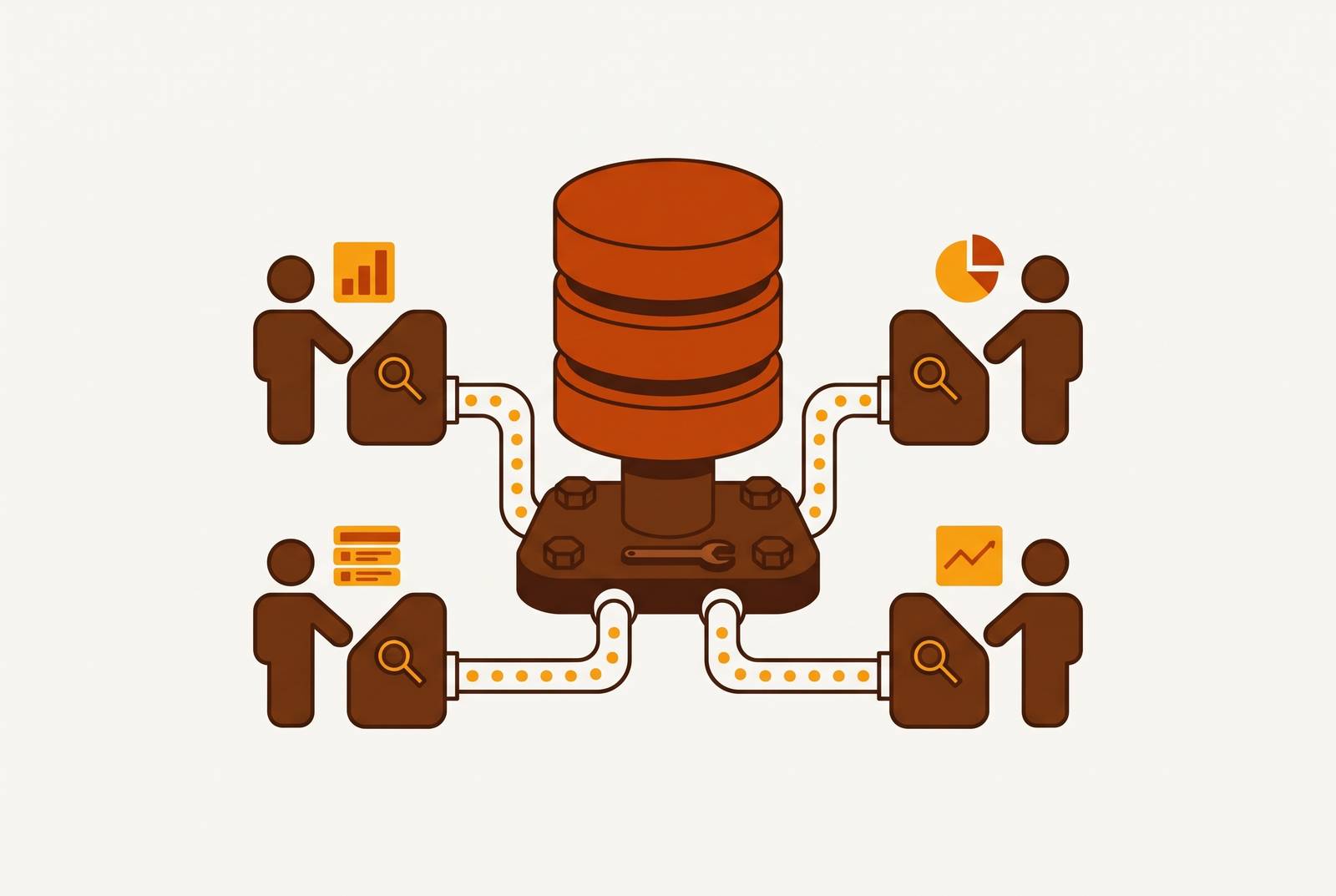
Different departments can then use that surface for different work. Marketing can see how campaigns are doing, HR can track hiring trends, sales can check pipeline health, and finance can compare forecasts with what was spent. Separate needs require the same interface to respect different access boundaries and resolve questions through the governed definitions.
The strongest objection is that many interfaces require more technical skill than advertised. A chat box is not an escape hatch from modeling. Without scoped permissions and a semantic layer, the user may still need an analyst to explain the schema or reconcile the result. The earlier layers are what make the interface’s promise credible.
Layer four: access governance as policy, not just permissions
Database permissions describe what a role can do, but policy determines who receives that role and when access ends. Role-based access control ties permissions to the jobs people do. A new sales hire inherits the sales role’s permissions. When they leave, revoking the role removes its associated access in one step, without reconstructing every grant from memory.
Exceptional access needs an expiry date. Time-bound grants end automatically after an investigation or project, instead of waiting for someone to remember to revoke them. Just-in-time access takes that further by provisioning access on demand for a bounded window, with no access as the baseline. Database and interface audit logs provide the record of who queried what, when, and what the query returned. Policy is easy to skip because day-one permissions appear sufficient, but that omission turns growth and staff changes into an expanding administrative burden.
What the team on the other side of this setup actually experiences
Consider a sales manager asking which accounts have not logged in this month. Before the setup, the manager files a ticket and waits for an analyst to turn the question into a query, find the data it needs, and limit it to the right scope. A follow-up means another request.
After the setup, the manager asks through the BI interface against live data, filtered to their territory. The answer uses the same metric definition finance sees, while the access controls limit the underlying records available to the manager. The follow-up stays in the same interface. Engineering is no longer the checkpoint for this recurring question and its variations.
Analysts can improve models, add data sources, and refine definitions. Some questions still need an analyst. Novel analysis and edge cases may demand interpretation that the governed model does not yet express, so self-serve is an answer to recurring, well-defined questions.
The objection worth taking seriously: why governance drift undoes a good setup
The uncomfortable objection is that a polished self-serve system can be worse than a queue. Suppose the product team introduces a new subscription tier, but the semantic definition of “active subscriber” never changes. Downstream queries now return a quietly wrong number. Because the interface looks authoritative, users may trust an answer that an analyst reviewing the question would have challenged.
Access can drift in the same way. Roles collect exceptions, and temporary grants that were never configured to expire remain available after their purpose has ended. Eventually, nobody is confident who can see what. An audit log can establish what happened afterward, but it cannot prevent exposure by itself.
This is a real limit on “one-time.” The setup is reusable, while its definitions must remain responsive to the business. The semantic model and access policies need to be maintained as living rules. Updating a YAML definition when a business rule changes is bounded work, unlike answering a hundred variations of the same question every week.
AI sharpens that trade-off. A tool generating SQL will query whatever the model exposes, including a stale or incomplete account of the business. The result may be beautifully formatted and wrong. Governance is the protection against that failure, and no amount of fluency in the answer repairs a neglected definition.
How agentic BI changes what the setup needs to support — without changing what the setup requires
Agentic BI extends the interface from answering questions toward surfacing anomalies, recommending actions, and triggering actions autonomously. The user becomes more of an overseer. For the analytical work, however, the agent still operates against database roles, metric definitions, and access policies. A recommendation does not give a read-only role permission to write, and greater autonomy does not remove the need for boundaries.
That makes the semantic layer useful beyond conventional BI. Grounding an AI query tool in a well-modeled semantic layer substantially improves natural-language-to-SQL accuracy compared with pointing it at raw schemas. Teams that have the four layers can add AI without building that foundation again, while teams that skipped definitions and governance must still put them in place before they can trust the output.
A company of roughly one hundred people does not need an enterprise BI stack to build this foundation. A direct database connection with row-level permissions, a lightweight semantic layer, and a governed query interface can cover the setup when backed by access policy and workload controls. The tool names are secondary to the configuration.
The engineering lift is therefore a one-time configuration problem with ongoing stewardship. Teams that build and maintain it can permanently remove the routine request queue as the route to well-defined answers. Teams that defer it keep paying the translation cost, one Monday morning at a time.