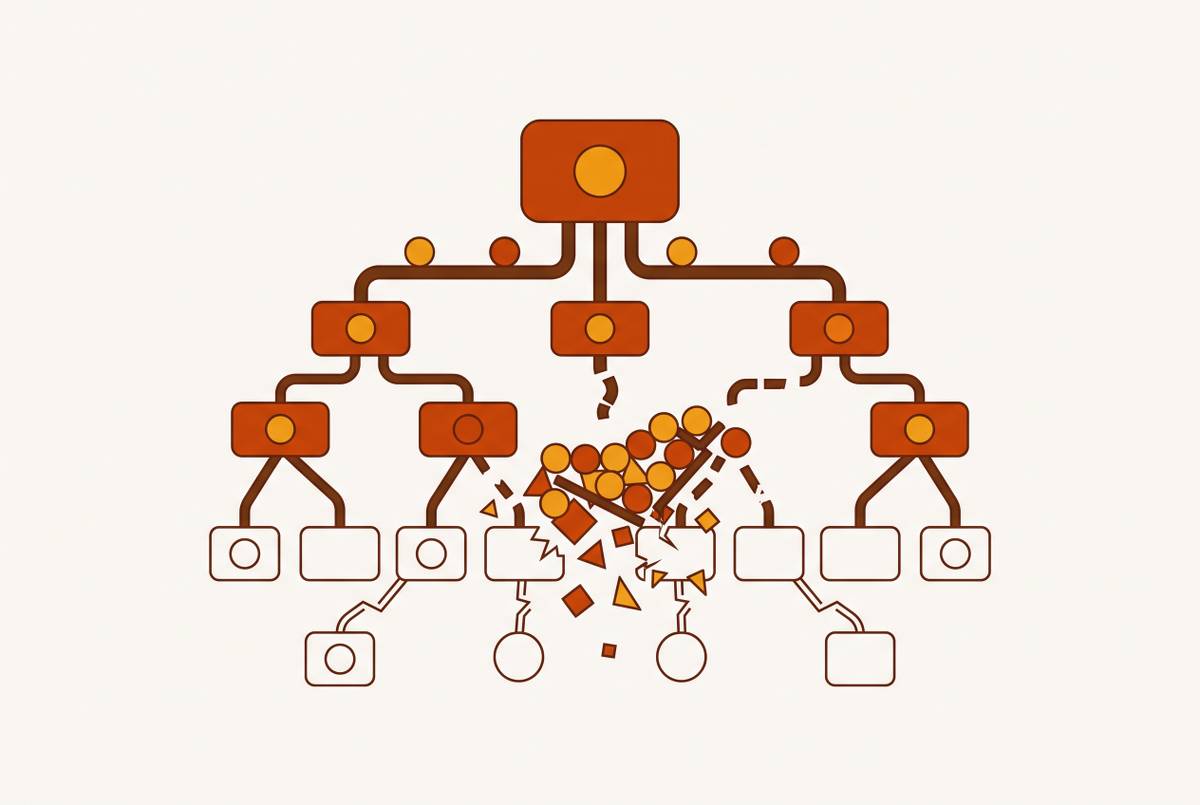
Data Theater vs Genuine Data Culture
Most organizations have the dashboards but lack the connective tissue between data and decisions.

"Data theater" is a business term, not a critique of performance art. It describes something specific: data that gets collected, cleaned, visualized, and presented, but never actually touches a decision. It looks exactly like the real thing. It is easy for a well-meaning organization to build data theater by accident.
Marketing technology writing going back to around 2013 uses the term, and the distinction drawn there still holds up. Strategic data is data that helps an organization choose between options in a way that lines up with where it's trying to go. Data theater is everything else: data that doesn't inform any choice, or worse, data that supports a choice that contradicts the strategy sitting one slide earlier in the same deck. The kicker is that the exact same dataset can be either one. Nothing about the numbers themselves makes them strategic or theatrical. What matters is whether anyone connects them to a decision.
That means a KPI can be flawlessly designed, gorgeously visualized, and still be theater. Design has nothing to do with it. And this isn't a problem confined to companies that don't know what they're doing. It's closer to a default state. Most organizations building data theater aren't faking anything. They're doing the work in good faith and assuming that good work automatically produces good outcomes. It doesn't, not without one extra step that's easy to skip.
Why the surface features of data theater and genuine data culture are nearly identical
You cannot tell the difference from a screenshot.
Both data theater and genuine data culture have dashboards. Both have recurring reporting cadences. Both have KPI reviews on the calendar and a data team fielding requests. The artifacts are identical. Organizations that complain about being "drowning in data, starving for insight" are almost never lacking infrastructure. They usually have plenty of it. What they lack is the connective tissue between the display and the decision.
Consider the problem of dashboards that look convincing but change nothing, like wallpaper. A dashboard can be built with real engineering care, refresh in real time, and use clean visual design, and still do nothing. If a metric turns red on that dashboard and nobody's job changes as a result, the dashboard is decorative. It doesn't matter how sophisticated the tool behind it is. Sophistication and function are two different axes, and a lot of budget gets spent optimizing the wrong one.
Then there's a subtler version of the same failure: two screens, two different numbers, same metric. Somewhere upstream, someone defined "planned downtime" or "active user" or "qualified lead" one way for one report and a different way for another. Nobody catches it until two teams argue in a meeting over which number is right. Both are, technically. That's the actual problem: the organization has plenty of data infrastructure and no shared truth running through it.
Neither failure appears in a demo. The failures are visible only when you watch what happens after someone looks at the data. Which raises an obvious question: if the failure is invisible until then, how would any organization know it's happening?
How widespread the gap between data aspiration and data reality is
Wider than most people would guess, and the numbers make the point without much editorializing needed.
Start with governance. The 2025 Gartner Evolution of Data and Analytics Governance for AI Survey, covering 62 organizations, found that only 26% of data governance programs build culture and communication into their strategy. The rest lean almost entirely on technical controls, policies, and tooling. That's a lot of organizations trying to fix a behavioral problem with a technical wrench.
Then there's trust. The 2025 DATAVERSITY Trends in Data Management Survey found that 61% of organizations list data quality as a top challenge, and 75% of leaders say they don't fully trust their own data for decision-making. Sit with that second number for a second. Three out of four leaders, in organizations that have already invested in data infrastructure, still don't trust what it tells them.
Ownership isn't improving either. Industry research consistently finds that ambiguous data ownership remains a persistent challenge across organizations, a pattern that shows little sign of improving year over year. That's not a tooling gap. Tools get better every year. This is stasis, which means it's cultural.
The BARC Data, BI, and Analytics Trend Monitor 2025 has data-driven culture in third place among organizational priorities, with larger organizations (over 2,500 employees) scoring it 7.8 out of 10. The BARC Data, BI, and Analytics Trend Monitor 2025 has data-driven culture in third place among organizational priorities, with larger organizations (over 2,500 employees) scoring it 7.8 out of 10. Smaller organizations score it lower, which tracks: fewer resources, more competing priorities, less infrastructure already in place to make a genuine culture possible.
Put those together and the pattern becomes clear. The aspiration is close to universal. The execution isn't. That gap is the whole subject of this piece.
The three organizational behaviors that distinguish genuine data culture from performance
Forget stated values. Nobody's mission statement says "we ignore our own dashboards." The difference between theater and the real thing is visible only in what people actually do, so that's where to look.
Behavior one: decisions trace back to data, and data questions trace forward to decisions.
In a genuine data culture, you can point to a specific number and a specific decision it changed. In data theater, reports get consumed, nodded at, maybe even discussed, and then the actual decision gets made somewhere else, for other reasons. A useful diagnostic question: "When did a dashboard change what you did?" If the answer is vague, or reaches back a year, or requires someone to think hard, that signal should be taken seriously.
Behavior two: definitions get fixed centrally, not renegotiated in every meeting.
The pattern where two people see two different numbers on two screens isn't a tooling failure. It's definitional chaos wearing a tooling costume. Genuine data cultures treat this as a governance job: fix the definition once, centrally, and let the display layer vary as much as it wants. Theatrical cultures do the opposite. They polish the display and leave the definition up for grabs. It's worth noting that data literacy among stakeholders is widely reported as a significant barrier, and a fair amount of that isn't a lack of smarts. It's a lack of shared vocabulary. Hard to be literate in a language nobody agreed on.
Behavior three: non-technical teams can self-serve answers without a ticket or raw database access.
If every ad-hoc question from sales or marketing turns into a request to the data team, data has quietly become a gatekeeping mechanism rather than a shared resource. Forrester research from July 2024 found that only 20% of non-IT professionals currently fulfill their own BI requirements. That gap, between having access to data and being able to actually use it, is the access gap in practice. Theatrical data cultures often do have access. What's missing is the permissioned, trustworthy, clearly-defined layer that makes access safe enough to hand out widely.
All three behaviors trace back to one root cause: governance treated as a technical control instead of a behavioral change. Which is exactly what that 2025 Gartner survey found at the organizational level. The pattern repeats at every scale you look at it.
Why governance programs fail to close the gap, and what minimum effective governance looks like
Governance is supposed to be the fix. Mostly, it isn't, and the reason is more interesting than "bad policy."
Nate Novosel, VP Analyst at Gartner, made the point at the 2026 Gartner Data & Analytics Summit in Orlando: governance programs don't fail because the policies are wrong. They fail because the organization never changes its behavior to actually follow them. A policy sitting in a wiki that nobody's workflow touches isn't governance. It's documentation.
The typical failure sequence goes like this: assemble a large central governance body, kick off a multi-year cleanup effort, promise value once the cleanup finishes, and wait. Stakeholders lose patience before anything ships. The program collapses, usually somewhere in the 12 to 18 month range. Nobody sabotaged it. It just never gave anyone a reason to stay engaged.
This matters beyond the reporting layer, too. Gartner's prediction is specific: by 2027, 60% of organizations that fail to address cultural challenges in data governance will also fail to govern AI successfully. Same failure mode, just scaled up into a system that moves faster and explains itself less.
So what does minimum effective governance actually look like, if the big-bang version doesn't work?
- Start from one specific business outcome, not from "our data has issues" in the abstract
- Identify the high-value data sitting behind the decisions that drive that outcome
- Fix that data to the minimum acceptable quality threshold, not to some theoretical gold standard
- Demonstrate the improvement, then move to the next target
Gartner calls this the trust model. Not enterprise-wide perfection. Targeted quality, aimed at specific decisions that actually matter.
There is also a stewardship angle to take seriously. In most teams, someone is already fixing data informally, quietly cleaning up a spreadsheet or double-checking a number before a report goes out, just to make sure it's right. That person is a natural ally. Find them and formalize the role. Announcing that "our data quality is broken" as an opening move tends to alienate exactly the person who's been holding the line.
The governance board meeting itself is one more signal worth watching. One unproductive meeting, and a member checks out permanently. Programs that don't make every participant feel like their voice matters lose people fast, and once attendance erodes, the program is already dying even if no one has noticed yet.
What self-serve analytics looks like when it works versus when it reproduces the theater
Self-serve is the go-to answer whenever data theater comes up. "Just let people query their own data." Sounds simple. Isn't.
That Forrester figure from July 2024 bears repeating here: only 20% of non-IT professionals currently fulfill their own BI requirements, even though the platforms to enable this are everywhere. Hex's 2025 research found that 70% of data professionals call self-serve a "worthy goal" while simultaneously reporting roadblocks getting there. Worthy goal, real roadblocks. That combination should sound familiar by now.
Most self-serve failures aren't access failures. They're governance failures wearing an access costume. Two people ask the same question, get two different numbers, and the tool never enforced one shared definition to prevent it. Forrester research found that nearly half of employees lack the ability to even search for existing insights, struggling just to find the reports and datasets that already exist. The data's there. The infrastructure for finding and trusting it isn't.
Ungoverned AI query tools don't fix this, they amplify it. An LLM sitting on top of messy, inconsistently defined data doesn't clean the data up. It just surfaces the same inconsistencies faster and with more confidence. Ask the same question twice, get two different answers, and trust collapses the moment someone in a meeting says "that's not what my spreadsheet shows."
What does working self-serve actually require?
- A semantic layer or shared metric definitions enforced at the platform level, so the same question returns the same number no matter who asks it
- Role-based, row-level permissions, so access can be granted without handing out raw database credentials
- Interfaces built for people who don't know SQL and shouldn't need to
That last point runs into a real tradeoff. Giving non-technical teams raw database access to clear the backlog of tickets creates a worse problem: one wrong query against production data can have real consequences. Permissioned, read-safe interfaces exist specifically to resolve that tension. Access without the risk.
How to audit your own organization for data theater
This doesn't need a maturity model or a scoring rubric. It needs a short list of pointed questions, the kind that can be asked in a single meeting and answered honestly.
On the decision layer, in the last quarter, which dashboard directly changed a decision? Who made the call, and what did they change?
- If a report vanished from next week's meeting, would anyone notice, and would any decision actually change as a result?
- When a metric moves, who's responsible for acting on it, and do they know that?
On the definition layer, ask two people from two different teams to define the organization's most important KPI. If the answers don't match, the "data problem" is actually a definition problem in disguise.
- How many versions of the same metric exist across dashboards, spreadsheets, and slide decks? Is there one canonical source, or several competing ones?
On the access layer, right now, how does someone in sales or support answer a data question? How many steps does it take, and how long does it take?
- Are people sharing database logins, exporting to spreadsheets by hand, or messaging an engineer directly? If so, why has that become the workaround?
If the honest answer to most of these is "I'd have to ask the data team," the data team has become the bottleneck. And a bottleneck that everyone routes around is, functionally, the theater.
The path from theater to genuine data culture, what the transition requires
The organizations that get this right aren't the ones with perfect data. They're the ones that stopped waiting for perfect data before making decisions with the data they had.
Leadership is the variable that doesn't have a workaround. Implementation research on system-level change (the SISEP framework) makes the point directly: leaders have to model data-informed decision-making visibly and routinely, not just when a report is due. The real shift is from data compliance, using data because a policy says to, to data practice, using data because that's genuinely how decisions get made. A leader who asks a data question out loud in a meeting, especially when the answer isn't convenient, does more for the culture than any dashboard redesign.
There's also a sequence that tends to work better than the alternative:
- Fix definitions before buying another tool. A shared glossary or semantic layer beats a new dashboard platform every time.
- Find the people already stewarding data informally and formalize their role before standing up a governance board from scratch.
- Pick one high-value decision, make the data behind it trustworthy, show the improvement, then expand.
Tooling decisions come after the cultural decision, not before it, but the right tooling still matters. Engineering teams that build safe, permissioned, self-serve access remove themselves as the bottleneck without losing control of the data. Non-technical teams that can get their own answers stop treating data as something that happens to them and start treating it as something they actually own.
Data theater doesn't persist because organizations are cynical. It persists because organizations solve how data gets displayed, dashboards, KPIs, reporting cadences, without solving how decisions actually get made that causes it. Genuine data culture is just the discipline of keeping those two things wired together, on purpose, every time.